 NFC Expert
 The history of the emergence of technology in the phone
It is believed that this is a relatively young development. Its appearance dates back to 2004: it was during this period that the three famous companies Nokia, Philipps and Sony organize the NFC Forum, and three years later they integrate the first NFC tags into a Nokia phone.
Such technology as NFC originates back in 1983. Then it was used to record the necessary data using radio signals. But the modern system appeared only in 2004. Three firms – Sony, Nokia and Philips – created an “NFC forum”, which allowed the transfer of some information with just a touch of devices. Near field communication technology has evolved over the years.
In 2006, “NFC tags” were created, and in 2007 such a tag was inserted into the Nokia 6131 phone. In 2009, the NFC forum created the Peer-to-Peer standard, which allows smartphones to exchange contacts with each other using NFC, links, initialize Bluetooth, and so on. Now this technology is present in almost every mobile device and is used for different purposes.
Smartphone models supporting NFC
It should be noted that not all phones support this data transfer technology. It is known that NFC support is available for such devices as:
- Apple iPhone (from 6S and 6S Plus);
- new Galaxy lineups from Samsung and smartphones from other manufacturers on the Android platform (starting from Android0).
Technology such as NFC is supported by most modern smartphones. For example, the latest iPhone releases, starting with 6s. Also famous Chinese firms and all new Galaxy variations.
To find out if the device supports NFS, you need to read the official characteristics of the phone, located in the settings or on the website with a description of the gadget.
Advantages and disadvantages
The main advantages are:
- low price;
- small dimensions of the device;
- high transfer rate;
- support on almost all mobile devices.
It is worth highlighting the cons:
- relatively small range;
- Not all devices are equipped with an NFC chip.
So, thanks to these notes, you have learned quick and easy ways to test your device for the ability to transmit information and interact with other technical means using Near Field Communication. By following the simple instructions in this article, you will also be able to find out for yourself if your smartphone has this technology, you will be able to integrate NFC into your phone and transfer the necessary files at high speed.
NFC has more advantages than disadvantages.
The main advantages are:
- Fast connection between two devices. When transferring files via Bluetooth, for example, it takes time to connect one gadget to another. When using NFS, this happens almost instantly.
- The range is very small, which prevents scammers from intercepting personal information or funds.
- Very small chip size. It can be placed on any device due to its small size, so NFC tags are used everywhere.
- Low cost. This chip is quite cheap, which allows you to purchase it without giving a large amount of money.
There are very few disadvantages of Near field communication, and the most important is the low transmission rate.
NFC how to enable? How to check if there is NFC on Android?
Would you like to try the technology in practice, but don’t know if this is possible on your device? Let’s check.
To do this, carefully open the back cover of a smartphone or tablet, in a situation where it can move away without damage and inspect the gadget’s battery.
In the presence of NFC development, you will see this abbreviation there. If the cover of the phone/tablet is not removable, then the corresponding icon or abbreviation will be located on the outside.
If for some reason you do not want or cannot remove the cover, you can make sure that such a communication method is available in the device settings.
Find the “Wireless networks” tab, then “More …” and if NFC is available on the device, then there will definitely be a corresponding item.

It’s very simple! In order to find out if there is an NFC chip on your favorite Android smartphone or tablet and enable it if necessary, you need to go to Settings -{amp}gt; Wireless Networks (or Advanced Features) -{amp}gt; NFC
If you do not have this option in the menu, then NFC is not available in your Android and there is no way to add it by downloading the “nfc program” or using a soldering iron.
Types of external NFC modules and their functionality
Don’t worry if you don’t find the built-in function, there is a way to connect NFC to your device. But you can only do this if the panel cover on the back and the SIM card slot on your smartphone/tablet are removable. Installing NFC in this case is not difficult.
The best solution is to install a special module – an external communication device. It is compatible with almost all smartphones, easy to use and gives you access to NFC without buying a new phone.
Main types: chips, SIM cards, external devices, stickers. The last of them are of two types: passive – which do not allow data to be exchanged, and active – use Bluetooth and Wi-fi communication channels for transmission, which significantly increases energy consumption.
These stickers are attached to the outer shell of the phone, which is also not very practical.
The most popular are the following:
- NFC SIM. Now available for purchase from most mobile operators. You can find out about the availability of such a SIM in the communication salon. You only need to install the finished card in your phone or tablet. This type of module is the most affordable and easy to install.
- NFC antenna. The second way, for which you will need to purchase an NFC antenna. You can do this in the communication salon. Next, the antenna is attached to the SIM card and inserted into the device.
As you have already seen, installing the module is quite simple and safe: you do not need to download additional applications or programs. However, these services do not completely replace the Android Pay app, but are just some of its many features.

An NFC tag is a miniature device in the form of a chip that can be attached almost anywhere: from the phone to being inserted under the skin!
We will not use such radical methods, but it is worth noting that contacts, settings, a URL and other data and commands can be placed on the chip. All gadgets can support the tag.
In order to read data from such a device, you need to find a specialized official application on Google Play and then, after installation, you can give the tag various commands for execution.
NFC Tags
NSF tags can be embedded in clothing, key chains, cases, and so on.
They are flat microchips with passive magnetic induction. Such tags are used for cashless payments, transmission and receipt of information, data.
Advantages:
- affordable, low price;
- availability of different designs and colors;
- it is possible to manage the settings of paired devices, phone.
Weaknesses:
- NFC is passive;
- it is not possible to use one label for several functions;
- memory capacity is very limited.
To insert such a tag into the phone, you need to:
- Order from the Internet or buy tags in a hardware store.
- Attach it to the body of the device.
- Install a service that allows you to manage NFC.
- Create a task for the tag.
- Check if the installed system works.
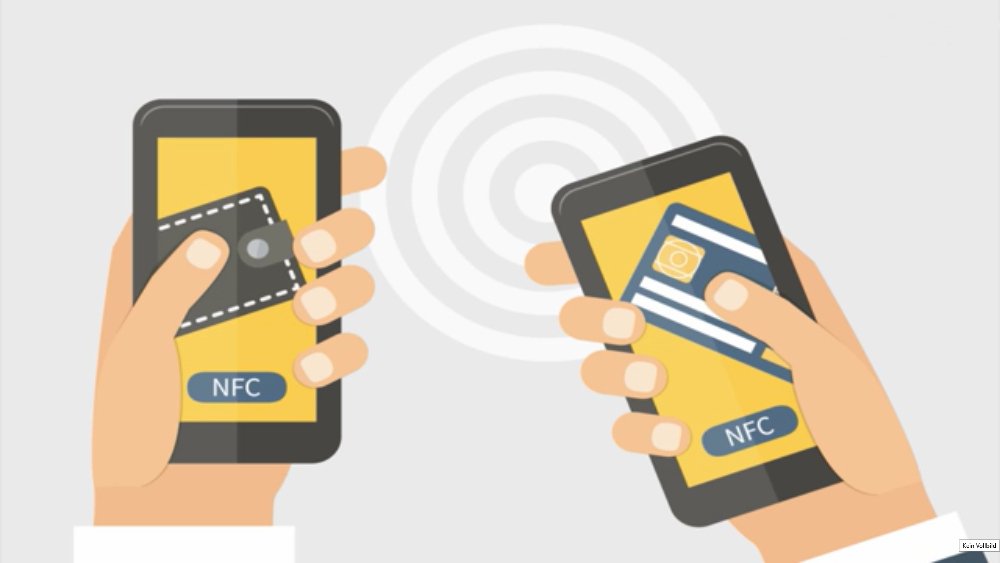
If the SIM card supports NFC, then it can be used to make payments, send and receive money to other devices.
Advantages:
- ease of use and installation;
- The NFS function is active.
Weaknesses:
- most likely you will need to change your phone number;
- it is necessary to link a new bank account;
- there is no additional identification when paying.
To install such a SIM card, you need:
- Contact the mobile operator you use;
- Make an order to exchange the card for a new one, which will have a contactless option;
- Check with the master how to insert the card correctly;
- Insert the card according to the instructions of the wizard;
- Link a bank card to the SIM card;
- Check the operation of the card using a contactless payment.
NFC antennas
NFS antennas are a flat module that consists of two elements. These elements are interconnected and are a chip module and an external antenna. Installed under the cover of the phone.
An external antenna is needed in order to exchange data and payment transactions, to manage some gadget settings.
Advantages:
- additional fasteners available;
- full cycle of data exchange;
- NFC function is active.
Weaknesses:
- few mobile operators release these antennas;
- not suitable for mobile devices without removable back cover;
- electricity consumption exceeded.
External antenna installation takes longer than tags and SIM cards. First you need to remove the back cover, pull out the SIM and remove the protective film from the surface of the antenna.

Next, you need to attach the antenna chip to the SIM card and put the card in place together with the chip, and close the battery from the top. The antenna unit must remain outside, and the antenna is superimposed on the battery. Now you can close the lid and use it for its intended purpose.
There are several types of external nfs modules – they differ from each other in size, location relative to the smartphone (inside or on the case) and ease of installation. Of course, the easiest option is to purchase a smartphone with a built-in nfc chip.
However, some phone models still lack it for various reasons. Just for such cases, external modules are provided that perform the same functions as the NFS chip built into the factory. Manufacturers whose devices support nfc often make a special mark on the case.
You can also check the availability of such a function in the settings:
- Main menu.
- Settings.
- Wireless networks.
- NFC (check the box if it is not there).
However, if the smartphone is not new and there is no built-in chip in it, then an attachable nfc module that can be bought in a store and used for almost any smartphone will help resolve this situation.
If we divide external modules into two large categories, it turns out that there are active and passive NFC modules.
- Active. Use a communication channel via Bluetooth or Wi-Fi. First of all, this factor implies high energy consumption.
- Passive. They are one-way and do not allow full data exchange between devices, as well as recording and saving data.
SIM cards

Sim cards with nfs module look no different from the most ordinary sim cards. They come in regular, mini and micro sizes. Many operators are engaged in the implementation of such sim cards, their cost is usually acceptable.
The obvious advantages of such a module include:
- availability (they are not difficult to find and buy in any region of the Russian Federation);
- ease of installation (inserted like a regular SIM card);
- NFC active.
However, there are some features of such a module:
- requires linking to a bank account or card;
- if the smartphone supports only 1 SIM, it will be necessary to change the phone number;
- does not require owner identification, which affects security.
NFC Tags
As an nfc adapter for a smartphone, special tags are also available. Outwardly, they are small rounded discs that are attached to the outside of the smartphone case. Most often they are very flat and therefore almost invisible to the touch.
Tags perform the same functions as the SIM module, but they have one advantage – they can be used to control the settings of the device on which such an NFS tag is installed.
The advantages of this type of outdoor unit include:
- affordable price;
- settings management;
- the ability to pay for goods and services;
- easy installation.
And the minuses are as follows:
- passive NFC function;
- the need to install additional applications;
- separate labels for each function.
Antennas
Another great option for those who want to equip their smartphone with an NFC function is an antenna. It is not difficult to purchase in hardware and electronics stores. The peculiarity of such a module lies in the fastening – part of the antenna is under the body, and part is on top.
The capabilities of the nfc antenna are quite wide. With its help, you can transfer money, pay, transfer data, manage gadget settings.
What other advantages does such a module have?
- reinforced fastening (due to the fact that the antenna is fastened both inside and outside the smartphone, the probability of losing it is almost zero);
- full package of features, active NFC function;
- does not require additional settings.
But it is worth considering the nuances of nfs antennas:
- compared to the above two modules, the prevalence of antennas is lower, and there are still few manufacturers;
- high energy consumption of the smartphone.
| Active NFC function | Self installation | Energy consumption | Availability | Payments and transfers | Manage Settings | |
| Tags | no | possible | low | yes | separate | |
| Antennas | yes | possible | high | – | yes | yes |
| SIM cards | yes | possible | low | yes | yes |
NFC activation
If you found it on your device, you must also activate access to NFC technology. You can do it like this:
- go to the “Settings” section and then “Wireless networks”, “More…”, where earlier you could make sure that NFC is available;
- confirm by clicking on the item “Allow data exchange when combining {amp}gt; device name {amp}gt; with another”;
- Android Beam is immediately activated on an Android smartphone. If this does not happen, click on it and select “Yes” so as not to disrupt the system;
Is it possible to pay by phone without NFC?
https://www.youtube.com/watch?v=JqxmDBnCUOs
Unfortunately, payment by a device that does not have an NFC module is not possible. Applications such as google pay will not work if the gadget does not have an NFS module built into it.
If the device does not support this technology, then neither the tags, nor the antennas, nor the SIM cards will be able to work in full.
Data exchange via NFC
When transferring data using NFC, there are some rules:
- Both devices must not be turned off or in sleep mode.
- Near field communication and Android Beam must be enabled on both gadgets.
- In order to transfer data, you need to bring two gadgets to each other and wait for a sound signal, which means that the devices have detected each other.
- Phones cannot be disconnected until the second beep sounds to inform you that the operation is completed.
The technology can also be used to transfer files.
To transfer data, you need to do the following steps:
- make sure that you have completed the activation of NFC and Android Beam;
- unlock the device, exit the “sleep mode”;
- check device detection with each other;
- connect;
- transfer data between devices;
- a specific beep will sound at the end.