 NFC Эксперт
 Use Aspirational Copy
Aspirational language is one of your most powerful weapons as a conversion copywriter. One of the best examples of aspirational copy on a landing page I’ve ever come across is this landing page by artist funding site Patreon:
Patreon connects working artists with fans of their work, who support their favorite artists financially through small donations and contributions. Think of it as an ongoing Kickstarter platform for artists. This means that, essentially, Patreon is asking its visitors to give money to artists.
The site could have taken numerous approaches to get visitors to part with their cash, but by using aspirational language, Patreon appeals to visitors’ desire to become a crucial part of the creative process.
People who support artists on Patreon aren’t giving someone money, and they’re not “donating” to a cause – they’re patrons of the arts, a term typically reserved for the kind of wealthy individuals after whom new wings in prestigious art galleries are named.
. Add a thank you page
Okay, it may seem like all these tips are pointing you away from confusing your audience … and maybe you’re right. Thank you pages are just another step in this process. Once someone lands on your page and completes an action, give them a visual confirmation that you have their information, the wheels are churning, they have reserved a spot.
Check out these 16 great (and not so great) thank you page examples so you can get yours just right.
. Poke Fun at Common Problems
One of the most effective ways to stimulate interest in a solution is by drawing attention to and acknowledging the problem. Many companies do this indirectly, but sometimes, a more straightforward approach can be more compelling, as this example from Meeting Hero demonstrates:
Productivity app Meeting Hero (which is now WorkLife) not only acknowledges the problem it tries to solve, but does so in a slightly humorous way. By adding a little character to the copy and gently poking fun at the fact that most meetings are terrible, this page makes the implied payoff of using the app more appealing.
Unfortunately, Meeting Hero lost this messaging when it became WorkLife, which favors the typically bland positioning you’ve seen countless times before. However, this example still shows that a little humor and directly acknowledging a problem everyone is aware of can be a great way to get visitors interested in what you have to offer.
. Let Customers Do the Selling for You
From a prospective customer’s perspective, there’s nothing more reassuring than a glowing review from a paying customer. That’s especially true for software companies like Salesforce—if becoming your customer means making a fairly expensive, long-term commitment, your prospects are naturally going to be skeptical.
By leveraging the positive experiences of your current customers, you prove to your prospects that they, too, can find success by purchasing your product or service.
This example from Salesforce is particularly good because it includes a picture of the woman whose testimonial is quoted. Putting a real, smiling face next to the copy only makes the testimonial that much more trustworthy.
Finally, it’s not a bad idea to place your testimonial next to the recognizable logos of other customers (see example #12). The more social proof, the better.
. Put Trust Signals Front and Center
The inclusion of trust signals on your landing page can be enough to convince even the most hesitant prospect to take action. This is particularly true for companies operating in potentially sensitive areas such as financial applications. One company that understands this is billing automation provider Recurly, as demonstrated in our second example of landing page inspiration:
As you can see, Recurly uses its impressive trust signals to great effect on this effective landing page. Not only are the company logos positioned very prominently, but the logos themselves speak volumes about how secure and trusted Recurly is as a service – if LinkedIn, Adobe, Zillow, and Groupon are satisfied customers, chances are prospects will be, too.
Aside from the excellent use of trust signals on this landing page, the copy is also very clever: “Sophistication your CFO expects. Ease of use your team demands.” This clearly indicates that Recurly’s ideal customers are financial professionals who report to an executive team but have their own managerial responsibilities. This might seem straightforward, but appealing to people with such precision in so little copy is harder than it looks.
By positioning itself in this way, Recurly demonstrates that it keenly understands the needs of its prospects and appeals to them in terms of the benefits of using their system. Brilliant.
. Let Images Do The Talking
Businesses offering somewhat abstract products or services might be tempted to use reams of text to explain what they do. However, in most cases, simple copy combined with a strong “hero” visual can actually explain what you do far more effectively than a wall of text. Case in point, this landing page from ad optimization firm Chatterbox Labs:
Even to experienced marketers, the concept of audience segmentation can be tricky to convey visually. However, this landing page makes excellent use of a hero image to accompany its brief copy to get the point across in an easily digestible, visually appealing way.
Rather than use words to explain how complicated audience segmentation can be, or how diverse audiences themselves can be, Chatterbox Labs uses a familiar scene in its hero visual – a busy New York City street scene. This implies the complexity of audiences without resorting to lengthy copy that would clutter an otherwise minimal page.
Granted, the call-to-action could be a little clearer, but you get the idea – let your images do the talking.
Simplify your forms
Though forms can be an important part of landing page design, I’m not going to dive in too deep since we have another (far more helpful) post on that here. But rule of thumb: Never ask for more information than you need. Try to keep it under seven fields of input.
Код
Чтобы оплата через Google работала, на телефоне пользователя должны быть установлены Google Play Services версии не ниже 11.4. Но не беспокойтесь, есть специальный метод, который подскажет, можно ли провести оплату или же стоит спрятать кнопку.
Для начала добавим нужные зависимости в build.gradle уровня приложения. Перед внедрением проверяйте актуальность версий!
dependencies { compile 'com.google.android.gms:play-services-wallet:11.4.0' compile 'com.android.support:support-v4:24.1.1' compile 'com.android.support:appcompat-v7:24.1.1'
}
Далее следует обновить AndroidManifest:
Теперь осталось совсем чуть-чуть:
- Создаём PaymentsClient в вашей Activity или в Fragment. Чтобы не захламлять эти классы, можно вынести весь код в методы GooglePaymentUtils, например. Тогда:
class MainActivity : AppCompatActivity() { private lateinit var googlePaymentsClient: PaymentsClient ... override fun onCreate(savedInstanceState: Bundle?) { super.onCreate(savedInstanceState) ... googlePaymentsClient = GooglePaymentUtils.createGoogleApiClientForPay(context) } ...
}
object GooglePaymentUtils { fun createGoogleApiClientForPay(context: Context): PaymentsClient = Wallet.getPaymentsClient(context, Wallet.WalletOptions.Builder() .setEnvironment(WalletConstants.ENVIRONMENT_TEST) .setTheme(WalletConstants.THEME_LIGHT) .build()) }Обратите внимание на константы:
WalletConstants.ENVIRONMENT_TEST — пока Google не разрешит выход в боевую среду, вы должны использовать именно её, чтобы самостоятельно протестировать флоу оплаты. Не пугайтесь, когда увидите предупреждение на диалоге Google Pay, что приложение не опознано.
WalletConstants.THEME_LIGHT — светлая тема диалога, также есть темная. - Отлично, у нас есть клиент, теперь мы готовы сделать запрос, можно ли вообще использовать оплату и показывать кнопку.
object GooglePaymentUtils { fun checkIsReadyGooglePay(paymentsClient: PaymentsClient, callback: (res: Boolean) -> Unit) { val isReadyRequest = IsReadyToPayRequest.newBuilder() .addAllowedPaymentMethod(WalletConstants.PAYMENT_METHOD_CARD) .addAllowedPaymentMethod(WalletConstants.PAYMENT_METHOD_TOKENIZED_CARD) .build() val task = paymentsClient.isReadyToPay(isReadyRequest) task.addOnCompleteListener { try { if (it.getResult(ApiException::class.java)) // можем показать кнопку оплаты, все хорошо callback.invoke(true) else // должны спрятать кнопку оплаты callback.invoke(false) } catch (e: ApiException) { e.printStackTrace() callback.invoke(false) } } } }PAYMENT_METHOD_CARD, PAYMENT_METHOD_TOKENIZED_CARD — говорят, что мы хотим видеть карточки из Google аккаунта пользователя и карточки, привязанные к Android Pay.
- Если мы можем показать кнопку, значит, мы должны повесить на нее обработчик нажатий
btnPaymentByGoogle.setOnClickListener { val request = GooglePaymentUtils.createPaymentDataRequest(price) AutoResolveHelper.resolveTask<PaymentData>(googlePaymentsClient.loadPaymentData(request), context, REQUEST_CODE)
}
Тут запомните, что price — это строчка. И самое важное, даже если вы вызываете AutoResolveHelper.resolveTask из фрагмента, то результат все-равно придет в активити (об этом чуть позже) [на момент написания статьи работает именно так, AutoResolveHelper не умеет возвращать результат во фрагмент].
fun createPaymentDataRequest(price: String): PaymentDataRequest { val transaction = createTransaction(price) val request = generatePaymentRequest(transaction) return request
}
fun createTransaction(price: String): TransactionInfo = TransactionInfo.newBuilder() .setTotalPriceStatus(WalletConstants.TOTAL_PRICE_STATUS_FINAL) .setTotalPrice(price) .setCurrencyCode(CURRENCY_CODE) .build()
private fun generatePaymentRequest(transactionInfo: TransactionInfo): PaymentDataRequest { val tokenParams = PaymentMethodTokenizationParameters .newBuilder() .setPaymentMethodTokenizationType
(WalletConstants.PAYMENT_METHOD_TOKENIZATION_TYPE_DIRECT) .addParameter("publicKey", TOKENIZATION_PUBLIC_KEY) build() return PaymentDataRequest.newBuilder() .setPhoneNumberRequired(false) .setEmailRequired(true) .setShippingAddressRequired(true) .setTransactionInfo(transactionInfo) .addAllowedPaymentMethods(SUPPORTED_METHODS) .setCardRequirements(CardRequirements.newBuilder() .addAllowedCardNetworks(SUPPORTED_NETWORKS) .setAllowPrepaidCards(true) .setBillingAddressRequired(true) .setBillingAddressFormat(WalletConstants.BILLING_ADDRESS_FORMAT_FULL) .build()) .setPaymentMethodTokenizationParameters(tokenParams) .setUiRequired(true) .build() }
Тут CURRENCY_CODE = “RUB”.
WalletConstants.TOTAL_PRICE_STATUS_FINAL — говорим, что стоимость покупки окончательная и больше изменяться не будет.Также есть варианты:
WalletConstants.TOTAL_PRICE_STATUS_ESTIMATED — стоимость примерная, и может измениться, например, после уточнения адреса.
WalletConstants.TOTAL_PRICE_STATUS_NOT_CURRENTLY_KNOWN — еще не знаем, какая стоимость.Не могу сказать, как на практике поведут себя последние две константы, так как не проверял ¯_(ツ)_/¯.
Остановимся на PaymentMethodTokenizationParameters и его методе setPaymentMethodTokenizationType:
- PAYMENT_METHOD_TOKENIZATION_TYPE_PAYMENT_GATEWAY
используется только если ваш payment processor в списке:Adyen
Braintree
PaySafe
Stripe
Vantiv
WorldPayТогда вместо
.addParameter("publicKey", TOKENIZATION_PUBLIC_KEY)
вы должны написать.addParameter("gateway", "yourGateway").addParameter("gatewayMerchantId", "yourMerchantIdGivenFromYourGateway") - Иначе используется вышеуказанный тип PAYMENT_METHOD_TOKENIZATION_TYPE_DIRECT.
Для этого вам необходимо запросить у провайдера платежных сервисов публичный ключ и передавать именно его в.addParameter("publicKey", TOKENIZATION_PUBLIC_KEY)
Теперь остается создать запрос.
.setPhoneNumberRequired — должен ли пользователь ввести номер.
.setEmailRequired — должен ли пользователь ввести email
.setShippingAddressRequired — должен ли пользователь выбрать страну. Тут можно ограничить число стран, для которых данная транзакция выполнится.
.addAllowedPaymentMethods — у нас это WalletConstants.PAYMENT_METHOD_CARD — карты из google аккаунта, WalletConstants.PAYMENT_METHOD_TOKENIZED_CARD — карты, добавленные в Google Pay.В CardRequirements мы указываем, что должны работать карточки систем Visa, Mastercard и других (МИР, например)
val SUPPORTED_NETWORKS = arrayListOf(WalletConstants.CARD_NETWORK_OTHER, WalletConstants.CARD_NETWORK_VISA, WalletConstants.CARD_NETWORK_MASTERCARD) - PAYMENT_METHOD_TOKENIZATION_TYPE_PAYMENT_GATEWAY
- Все, мы создали запрос, отправили его через клиента и ждем результат через AutoResolveHelper.
Как вы помните, результат придет в активити.
override fun onActivityResult(requestCode: Int, resultCode: Int, data: Intent?) { super.onActivityResult(requestCode, resultCode, data) when (requestCode) { LOAD_PAYMENT_DATA_REQUEST_CODE -> { when (resultCode) { Activity.RESULT_OK -> { if (data == null) return val paymentData = PaymentData.getFromIntent(data) } Activity.RESULT_CANCELED -> { // Пользователь нажал назад, // когда был показан диалог google pay // если показывали загрузку или что-то еще, // можете отменить здесь } AutoResolveHelper.RESULT_ERROR -> { if (data == null) return // Гугл сам покажет диалог ошибки. // Можете вывести логи и спрятать загрузку, // если показывали val status = AutoResolveHelper.getStatusFromIntent(data) Log.e("GOOGLE PAY", "Load payment data has failed with status: $status") } else -> { } } } else -> { } } }
Вот и все, в paymentData у вас будет токен, который следует отдать вашему серверу. Дальнейшая логика зависит от вашего payment processor.
Help Visitors Visualize a Better Life
I’ve said it before, and I’ll say it again. People don’t want to buy things – they want to solve their problems and make their lives better. Helping prospective customers visualize this better life can be a powerfully persuasive technique, as this example from small business software company Wave proves:
Wave is essentially a bookkeeping, taxation, and invoicing tool. Although all these things are crucial to the success of any small business, they’re not exactly sexy and they’re definitely not why people launch their own businesses in the first place.
The combination testimonial/hero image is a shrewd move. It not only shows a real, satisfied customer (which serves as a trust signal), it also helps visitors imagine their life as a Wave customer. To most entrepreneurs, the idea of “doing what they love” while a single software package “does the rest” is very alluring, and this is exactly what Wave wants prospects to feel.
Test your copy & CTA
Speaking of keeping it simple, let’s talk landing page copy. Anytime you’re writing copy for a designed page, keep the layout in mind. You don’t want your audience to be staring down a wall of text that they need to comb through to get to the point. When you can, use bullet points, headers, and subheads to drive your point home concisely.
But as always, test your copy. And test your CTA. And then test some more copy. And then test CTAs again. You’re never going to know what resonates with your audience until the numbers tell you the truth.
You’re going to have to trust me that this landing page has been tested against other copy and different forms and different CTAs. Turns out, competing in AdWords (without just raising bids) is pretty compelling.
Keep the design straightforward and easy to navigate
Have you ever landed on a page and just … gotten lost? It’s happened to me. I’ll be looking to buy concert tickets and all of a sudden, I just can’t find the “Buy Now” button because there are too many dropdowns and display ads and distractions.
Don’t lose conversions because of this. Your landing page design should reflect your brand colors and look like something you’d want to include on your website. Along with keeping your forms simple, you want to make the whole page navigable.
Your Company’s Culture Will Improve
Having a phenomenal company culture will improve your business in so many ways. Having a building full of motivated, competitive people is great for morale as a whole.
Make a Bold Statement
Sometimes, what you’re trying to do is so important, so powerful, that you don’t need to do much else besides get people to stand up and take action. Case in point, this page from Last Days of Ivory:
Design-wise, it doesn’t get much bolder than this. The contrast of the white-on-black is a powerful visual statement, and there’s very little going on aside from the logo (which also serves as an unorthodox call-to-action), some branding icons to show which organizations the campaign is affiliated with, and the “real” CTA in the top-right corner.
In examples like this, simplicity and the power of the message do all the heavy lifting, and to great effect.
Релиз
Вам сказали, что все хорошо и можно выпускать приложение. Первым делом вас попросят
(с аккаунта продавца (merchant)).
Далее вас могут попросить прислать PCI Compliance. Эти документы подтверждают, что ваш payment processor соответствует стандартам безопасности по работе с картами. Запрашиваете у него и отправляете в поддержку.
Как только вы выполнили эти два пункта, вам скажут, что можно поменять WalletConstants.ENVIRONMENT_TEST на WalletConstants.ENVIRONMENT_PRODUCTION. Также может потребоваться поменять TOKENIZATION_PUBLIC_KEY, если вы использовали ключ с тестовой среды вашего payment processor.
Вот и все, теперь протестируйте реальную оплату и можете выпускать релиз в маркет!
Спасибо и удачи!
Know Your Brand and Take ‘Risks’
Let’s face it – most marketing material is deathly boring. One reason for this is because too few brands are willing to take creative risks with their campaigns. One brand that doesn’t shy away from risk is Tapely, an online mixtape sharing site:
Digital music services like Spotify are great, but a curated playlist will never have the same raw feel as a mixtape. That’s why Tapely channels the emotion, energy, and attitude of the bands that changed our lives and the bootlegged tracks we shared with our friends to create a landing page that doesn’t take any shit from anybody.
Only you can decide how far you can go with your marketing campaigns, and obviously this approach won’t work for everyone. However, for certain lifestyle brands, doing something that most people might think of as a little risky can strengthen your brand and offer a sense of authenticity that’s sadly lacking from most marketing material.
Make sure it loads quickly
If you’re a marketer, you probably already have landing pages whirring away as well as your website. If you’re seeing a high bounce rate on a particular page, load time could be the culprit. It can be easy to cut corners with one-off landing pages, but make sure nothing on the page is too heavy or big.
Appeal to Prospects’ Emotions
Regardless of what prospects are looking to buy, they want to feel something – better about themselves, more secure in a decision, adequately informed about an issue.
One of the biggest reasons why most B2B content and marketing is so bland is because many companies purposefully avoid trying to solicit an emotional response from their prospects – a mistake that results in dry, forgettable messaging.
Done well, appealing to prospects’ emotions can be highly effective. This landing page from Happify, an app that tracks emotional behavior over time to promote a happier outlook, leverages this technique very well:
In addition to the visuals, which suggest the kind of freedom and time to relax and indulge that many of us lack these days, the copy is powerfully persuasive. It creates a sense of urgency without being overly forceful, and hints at the benefits of using the app without resorting to the hard sell.
The combination of the imagery and copy results in an emotionally appealing page that spurs the curiosity of the prospect and leverages their desire for an emotional payoff. Speaking of emotional payoffs…
Put the important information above the fold
Just like an email, you want to make sure when someone is clicking through, the important stuff is visible first. This is particularly important for highly actionable pages, like buying tickets or entering a contest.
Things you can put below the fold: any testimonials, case studies, or client logos. Your own terms and conditions. Suggested content (e.g., if you liked this, you’ll also love our guide on our to make your lead forms pop!).
This Guideline page does this really well; there’s minimal text, a simple form above the fold, and more details below.
Speak Directly to Your Visitors
Another mistake that far too many B2B companies (in particular) are guilty of is using distant, third-person language in their copy. This might be suitable in certain situations, but for the most part, all it will do is alienate your visitors.
A lot of marketers talk about the value of genuine connections, simply because they’re so rare. Similarly to the example above, you want your visitors to feel something when they visit your site or arrive on your landing page, and one way to do this is by directly speaking to your prospect. Check out this example from the now-defunct video chat app Awesometalk:
Although Awesometalk folded a while back, this landing page remains a great example of how directly addressing your visitors and appealing to their emotions can make even a relatively common online service significantly more attractive.
The copy directly appeals to the visitor and makes it easy to convert, two crucial factors for a business operating in a (very) crowded space. If nothing else, this example shows how simple copy can have a big impact.
Agency costs
Some small businesses opt to have an agency handle their PPC work to saving them the time and stress. This isn’t cheap, and even the smallest of boutique agencies will take a percentage of your ad spend, regardless of ROI. Agency cuts typically hover around the 10% mark, though this varies from one agency to another. Also, some agencies may guarantee a threshold ROI, whereas others won’t.
Even still, having a seasoned expert run your account can save you from costly errors and also help you yield the highest returns on your ad spend. To ensure you choose an agency that is worth the investment, make sure you check off all your boxes when vetting them. You can use our checklist below:
There’s a lot more than price to consider when choosing an agency.
Obviously it’s in the agency’s best interests to deliver results (to reduce churn and retain clients), but even if your ads don’t result in any conversions, you’ll still have to pony up and pay your agency unless it’s explicitly stated otherwise in your contract.
Are your landing pages costing you conversions?
If you’re concerned about how well your landing pages are really performing, WordStream’s Landing Page Grader can help. This completely free tool evaluates the strength of your landing pages against benchmarks for competitors in your industry, shows you what they’re doing right, as well as areas that can be improved.
What do you think? Should small businesses steer clear of minimalist designs like this, or is there room for contemporary aesthetics on landing pages? Have your Quality Scores improved or suffered after implementing a page with a design like this? I’d love to hear your thoughts.
Call-to-action
Your landing page CTA should also be clear and directly related to your offer. In fact, A/B testing has shown that by simply changing the CTA copy — even one word — conversions can increase by about 161%!
Therefore, it’s important that you put substantial time and effort into making sure your landing page CTA is easy to spot upon first glance and converting your visitors.
Some very simple ways to improve your landing page CTA include:
Can contemporary landing page designs be considered relevant by google?
As I mentioned at the beginning of this post, the idea of examining landing page relevance in relation to Quality Score came from a couple of comments left on a previous post.
One commenter noted that I favored clean, minimal designs. While I do personally enjoy contemporary trends in web design, my choices weren’t solely for aesthetic reasons and the question of relevance is an important one. Although I believe there’s a lot to be learned from the landing page examples in my previous post, landing pages that aren’t perceived as relevant to their accompanying ads by Google could harm advertisers’ Quality Scores.
The question, then, is whether minimalist landing pages can be considered relevant by Google’s standards. Let’s apply Google’s relevance criteria to a real example.
First, I searched for a term that was likely to result in a landing page with a more modern aesthetic, in this case “ad optimization.” There were several ads for major brands like Adobe on the SERP, but I wanted to look at a smaller player, so I went with one of the ads from the sidebar on the right of the organic results:
This is the landing page the ad above took me to when I clicked on it:
For the sake of space, I included as much screen real estate in the screengrab as I could. This content is all above the fold. Some landing pages I featured in my previous post consisted solely of this style of design – a snappy tagline, some very brief explanatory copy, and a single call to action.
Scrolling down this page, however, we find some information that would be more useful to Google’s crawlers:
Sure, the copy itself also aligns pretty closely with contemporary trends, but in terms of what Google’s crawlers are looking for, there’s definitely a lot more to work with. The ad itself isn’t great, and I’m wondering how this landing page impacts its overall Quality Score.
Capture and convert more leads with the cro toolkit
So, now that we’ve looked at some beautiful landing page inspiration from around the web, it’s time to start making some of your own.
WordStream’s CRO Toolkit is your one-stop shop for conversion rate optimization. Thanks to an intuitive drag-and-drop interface and unlimited A/B testing functionality, the CRO Toolkit makes creating and optimizing pop-ups and landing pages easier than ever before.
The CRO Toolkit gives you everything you need to entice your site visitors to take action at an exceptionally high rate. Start your free trial today!
Dayparting
Also known as ad scheduling, dayparting is the practice of specifying when you want your ads to appear to prospective customers. Although your ads will still have to go through the ad auction process, you can tell Google when you want your ads to be displayed.
This is especially useful for local businesses that want to attract customers to a physical location through their ads. If you run a bakery that closes at 7pm, for example, you may not want your ads to be shown outside your normal business hours.
How does budgeting work with google ads costs?
Let’s move on to the next component of Google Ads cost: budgeting. All too often, advertisers see their Google Ads budget for the month get burned up in a matter of days, leading them to believe Google Ads prohibitively expensive. This isn’t necessarily the case; more often than not it’s the result of a misunderstanding of how Google Ads budgeting works. So let’s set the record straight. Here are the terms to know:
- Budget: How much you’re able to spend on Google Ads
- Bid: The most you’re willing to pay for a click on your ad.
- Spend: The amount Google takes out of your budget when an ad participates in an auction.
- Cost: The actual amount you pay for a click on your ad.
How much do google ads cost? key takeaways
We’ve covered a lot in this guide, so let’s go over the key takeaways that you can use to orient yourself in terms of what you could spend in Google Ads.
- Before even getting into calculations, the cost of Google Ads for a business will depend on its industry, customer lifecycle, and current consumer trends.
- Google Ads is based on an auction system that rewards high-quality ads with lower costs and better ad placement.
- You can exercise tight control over how your Google Ads budget is spent using tactics like ad scheduling, geotargeting, and device targeting.
- The average cost per click in Google Ads is between $1 and $2 on the Search Network.
- The average cost per click on the Display Network is under $1.
- The most expensive keywords in Google Ads and Bing Ads cost $50 or more per click. These are generally highly competitive keywords in industries that have high customer lifetime values, like law and insurance.
- Giant retailers can spend up to $50 million per year on paid search in Google Ads.
- The average small- to mid-size business spends anywhere from $1,000 to $10,000 per month on their Google paid search campaigns. That’s $12,000 to $120,000 per year.
How to determine your average daily budget
To calculate your average daily budget, simply take your budget for the month for that campaign and divide it by 30.4. What should your monthly budget be? This depends on:
For example, you may want to dedicate more budget to Campaign A, advertising your best-selling product, than to Campaign B, which promotes content to prospective customers at the top of the funnel.
You can also plug different daily average budget numbers into the budget report mentioned above to see how it would impact your monthly spend.
The Google Ads budget report gives you visibility into how much of your budget it spent on any given day.
You can also play around with different daily budget adjustments to see how it will impact your monthly spend.
For more help with budgeting, check out our Complete, Digestible Guide to Google Ads Budgets.
Industry
The biggest influence on Google Ads pricing is industry. For example, the business services vertical (legal, accounting, real estate, etc.) is one of the more competitive verticals in Google Ads, which generally translates to higher costs per click (CPC). This is due to the nature of the professional services industry: one new client could yield upwards of $1,000 – $10,000 depending on your business, so a CPC of $50 is a small price to pay for that client. 
On the other hand, businesses in the arts and entertainment vertical have lower CPCs, but they need to reach a lot more customers to hit that $1,000 – $10,000 number.
You can see our latest paid search advertising benchmarks for 20 different industries here.
Is landing page relevance determined by pass/fail logic?
Now that we know a little more about the role that landing page relevance plays in Google’s evaluation, we need to look closely at Google’s language in its documentation on this process. From the official Google page on landing page experience:
As you can see, with only three possible statuses, it would appear that Google’s approach to determining landing page relevance is pretty rigid.
If you’re a regular reader, you’ll know that WordStream founder Larry Kim is something of a Quality Score nerd (and that’s putting it mildly). Imagine Larry’s excitement when he came across a blog post by British PPC and SEO agency Impression that appeared to confirm that Google applies Boolean (true/false) logic to evaluating landing page relevance in its Quality Score calculations!
As Impression explained in their post, one of their PPC managers found a snippet of code that included the string variable isLandingPageQualityAcceptable. As the only possible answer to a question like this is either “yes” or “no,” it prompted a great deal of speculation about how Google actually evaluates the relevance and quality of landing pages in its Quality Score calculations.
It’s entirely possible that Google actually uses some sort of hidden sliding scale to determine these values. Of course, it’s equally possible that Google secretly employs a vast army of genetically enhanced telekinetic super monkeys to check landing page relevance manually – we just don’t know. Still, this sort of stuff is worth thinking about.
However, I asked Larry what he thought about the role of landing page relevance in Quality Score, and his answer might surprise some of you.
“Landing page quality is a very small component of AdWords Quality Score, and it’s more of a pass-fail kind of thing,” Larry told me. “For example, if you’re bidding on ‘My Little Pony’ keywords and sending those clicks to illegal drug pages, then you fail and your Quality Score is a ‘fail.
’ But provided that there is a small amount of relevancy between the keyword/search query and landing page you’re sending people to, you’ll get a ‘pass.’ There are no ‘Quality Score bonus points’ in terms of making the landing page even more relevant.
Landing page relevance and quality score
Unlike some aspects of the mysterious Quality Score “secret sauce,” we know that Google takes landing page relevance into account when calculating Quality Score. Well, technically, Google considers a number of landing page quality score factors, but relevance plays a big role.
Let’s look at an example to illustrate what this means, using the search term “fishing equipment”:
For me, this ad for Bass Pro Shops was the only result, so unless I want to refine my search query (which I don’t), this is all I’ve got to work with. Although I personally know that Bass Pro is a great place to buy fishing equipment, I don’t know whether the landing page will actually provide me with the gear I want or not until I click on it:
Obviously, landing page quality isn’t off the charts here, but we’re primarily concerned with its relevance to the search query, not how it looks. In this case, since I only searched for “fishing equipment,” it’s actually pretty relevant.
Google doesn’t know whether I’m in the market for a new creel (the basket you hold the fish in, if you’re wondering) or some replacement line, so this page makes the grade.
Now, as you might expect from Google, the definition of what constitutes a good landing page experience is a little vague and can vary widely from one page to another. For example, according to Google, landing page experience is evaluated based on:
- Relevant (determined mostly by the presence of keywords on the page), useful and original content
- Transparency and trustworthiness
- Ease of navigation
- Encouraging visitors to spend time on your site
Let’s look at the criteria above in relation to our Bass Pro Shops example. The content is definitely relevant to my query, and, in the strictest sense of the word, useful to me as a visitor. I’m not sure whether you could call this page’s content “original,” but even if not, two out of three ain’t bad.
Transparency doesn’t really apply here, because the page isn’t asking me to submit any personal information. In terms of trustworthiness, I’d wager that being one of the largest sporting goods retailers in North America probably meets Google’s expectations.
Ease of navigation is questionable in this example. Sure, you’ve got clearly marked product category navigational links on the left, but other than that, it’s a little confusing. For Google’s purposes, these navigational links also serve as keywords, which is primarily how Google evaluates the relevance of landing pages.
Live by these landing page best practices!
Take these tips and prosper! Here’s a recap:
- Align your landing page with the goal of your ad campaigns
- Simplify your forms
- Test your copy and CTA
- Keep the design straightforward
- Leverage case studies and social proof
- Keep your landing page mobile-friendly
- Make sure it loads quickly
- Put important information above the fold
- Update your landing pages regularly
- Add a thank you page
- Build your landing pages for SEO
Now, good luck out there in landing page land! Let us know if you have any secret, trusted tips of your own.
Message match
Although this seems like an obvious tip, you’d be surprised how many ads don’t advertise the same thing as their landing page. When you run a Google Ads (AdWords) campaign, make sure your promotion remains the same throughout your entire advertising process. This is referred to as message matching.
If your PPC ad is promoting a free trial, your landing page should also feature a free trial. If your PPC ad highlights a new white paper, the landing page should also focus on that white paper. The language in the ad should also be similar. This kind of message matching consistency helps reinforce a positive landing page experience, a variable Google uses for your Quality Score.
Step #1: quality score
When someone searches on Google, Google looks to see if any advertisers are bidding on keywords relevant to that query. If yes, an auction is triggered and Google enters all relevant ads into the auction. Its first step in choosing a winner is to assign each ad a Quality Score.
To learn more, head on over to this post: What is a Good Quality Score for Each Type of Keyword?
Step #3: cost per click
If your ad gets shown, you only pay if someone clicks on it. But as mentioned above, you don’t necessarily pay your maximum bid. The Google Ads cost per click formula is: the Ad Rank of the ad below yours divided by your Quality Score, plus one cent.
With this formula, an advertiser can pay less per click than another advertiser in the SERP and still be in the higher position due to a better Quality Score. This is why advertisers with a small budget can compete with big spenders on Google.
For a more in-depth explanation on the Google Ads auction, head to our post >> How Does Google Ads Work? The Complete, Visual Guide.
Takeaways from these landing page examples
You can catch our landing page best practices here, but these are some of the key themes you’ll see woven throughout this post:
- Build trust: Include logos of your biggest clients, awards, review and testimonials (ideally with a headshot of the customer).
- Organize your information: Use not just font sizes, but colors, backgrounds, font weights, and the layout to give the reader a hierarchy.
- Keep the layout clean: You’ll see that these pages all have visuals, alternating background colors, F and Z patterns, with plenty of white space.
- Repeat the CTA in long pages: Long landing pages are effective, but make sure you have the CTA prominent at the beginning, middle, and end.
The key influence on pricing in google ads: keywords
In some ways, you can think of PPC advertising roughly along the same lines as traditional print advertising; you’d expect to spend more on a glossy full-page ad in a national magazine than you would for a classified ad in a local newspaper.
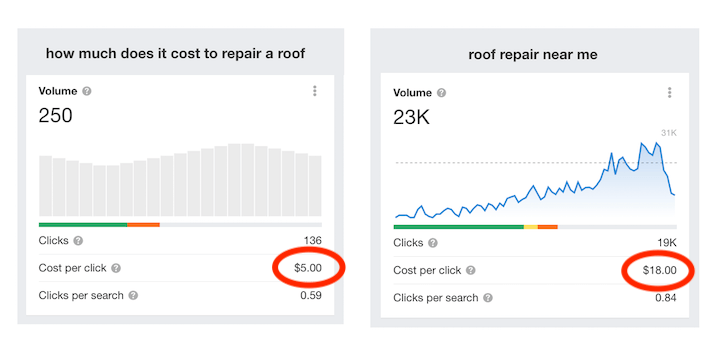
In digital marketing, however, the pricing isn’t influenced by the format of the ad, but rather the intent of and competition for the keywords you’re bidding on. So you can expect to spend more on a high-intent keyword like “roof repair near me” than something lower intent like “how much does it cost to repair a roof.”
What are the most expensive keywords in bing ads?
As Bing is growing in market share, we decided to conduct a similar study to find the most expensive keywords in Bing Ads.
Listed below are the most expensive keyword categories in Bing Ads, as well as the average cost-per-click for each:
- Lawyers – $109.21
- Attorney – $101.77
- Structured settlements – $78.39
- DUI – $69.56
- Mesothelioma – $68.95
- Treatment – $67.46
- Annuity – $67.31
- MBA – $62.78
- Phone – $53.94
- Insurance – $53.14
- Diploma – $52.73
- Rehab – $49.67
- Cloud – $49.52
- Accounting – $44.82
- Exterminator – $44.66
- Mobile – $43.04
- Business – $40.75
- Repair – $39.80
- Plumber – $36.97
- Podiatry – $29.89
You can see the full infographic and the category breakdown here.
Of course, these are just some of the hundreds of thousands of keywords that businesses all over the world are bidding on, and costs can vary widely depending on a wide range of factors. Even if you’re in an industry with high average costs-per-click, such as insurance or legal services, it doesn’t necessarily mean you’ll be forced to pay these amounts for each click on your ad.
Overall, the average CPC of keywords across all industries typically ranges between $1-2—significantly less than the averages from Google Ads and Bing listed above.
Furthermore, it’s important to take ROI into account. These industries can afford high CPC’s because the average lifetime value of a customer is so high.
What are the most expensive keywords in google ads?
As Google owns the largest paid search platform, we’ll focus on Google Ads first.
Listed below are the most expensive keyword categories in Google Ads, and the average cost-per-click of each. It’s worth noting that these are keyword categories, not actual keywords themselves—in some cases, the CPCs of keywords within each category may be higher than the averages stated:
- Insurance – $54.91
- Loans – $44.28
- Mortgage – $47.12
- Attorney – $47.07
- Credit – $36.06
- Lawyer – $42.51
- Donate – $42.02
- Degree – $40.61
- Hosting – $31.91
- Claim – $45.51
- Conference call – $42.05
- Trading – $33.19
- Software – $35.29
- Recovery – $42.03
- Transfer – $29.86
- Gas/Electricity – $54.62
- Classes – $35.04
- Rehab – $33.59
- Treatment – $37.18
- Cord blood – $27.80
You can check out the full infographic and learn about the methodology behind the data here.
We then ran a second report a few years later. The results were similar, but we did see some new highly expensive keyword niches on the list, and also that average CPC’s (unsurprisingly) had gone up. You can check out the list of the top 25 most expensive keywords here.
What is the cost-per-click for long-tail keywords?
People sometimes like to point at the grand, show-stopping keyword categories above as a definitive example of how expensive Google Ads can be. The reality, however, is that these keyword categories only make up a small portion of total search volumes.
This is the kind of opportunity that long-tail keyword targeting presents to advertisers. In addition to making up the vast majority of searches,
You can learn more in this guide to long-tail keywords.
Keep your landing page mobile-friendly
As is important for any marketing, you want to make sure your landing pages are compatible with any device or viewable on any screen size. A lot of plug-and-play landing page solutions have this feature built in, allowing you to see common sizes before launching your shiny new page. Just a tip:
Play it safe by keeping your buttons and/or forms toward the center of a full-size page with a single-color background. That way, shrinking and stretching on whatever strange screens your page may encounter is less likely to break something important.
How much do typical businesses spend on google ads?
Usually, once someone has asked about the average cost-per-click of a PPC ad, their next question will be how much do “typical” businesses spend on Google Ads as part of their larger online marketing costs. Unfortunately, this is another question without an easy answer.
If you look at the average CPC data below, you’ll see that the top five most competitive terms are found in:
- Insurance
- Online education
- Legal
- Marketing & advertising
- Internet & telecom
In our latest search advertising benchmarks report, we found these industries to have the highest average costs per click:
- Attorneys & legal services ($8.67)
- Dentists & dental services ($6.49)
- Home and home improvement ($5.75)
- Finance and insurance ($5.16)
- Business services ($4.90)
There’s also significant overlap in the industries with the highest average cost per lead:
- Attorneys & legal services ($73.70)
- Furniture ($64.72)
- Finance and insurance ($62.80)
- Business services ($62.18)
- Career and employment ($53.52)
As you can see, companies in the insurance and legal industries spend the most per month on Google Ads. Big brands in the industries above can spend $40 to $50 million a year, but this isn’t exactly relevant information to would-be advertiser who’s still on the fence about Google Ads. And good news for you, you don’t need to spend millions on Google Ads to make it work for your business.
Spending limits
Originally, Google could spend up to 20% more than your daily average budget in this manner—until October 2022 when it announced it could spend up to 100% more of, or double, your budget—if it means more clicks or conversions. This means that if you set a daily average budget of $50, your daily spending limit is $100.
You will never pay more in a day than your daily spending limit, and you will never pay more than a month than your monthly spending limit (your average daily budget x 30.4; although if you’re not paying for Google Ads with the invoice method, you can set a monthly spend limit at the account level).
 Image source
How much do small businesses spend on google ads?
As you might expect, the amount that small businesses spend on PPC varies widely. Some, such as for real estate, home services, and healthcare, spend $1,000 – $3,000 on Google Ads per month.
Here’s what we found in our latest vertical benchmarks reports:
But for mid-sized companies and agencies, we see anywhere from $7,000 – $30,000 per month. Historically, from the very smallest mom-and-pop-shop to the mid-sized PPC agency—we’ve seen an average of $9,813 per month spent on PPC advertising.That’s still a pretty wide range, but you can at least orient yourself with respect to where you fall on the spectrum.
You can find more helpful tips and strategies in our Small Business Guide to Google Ads.